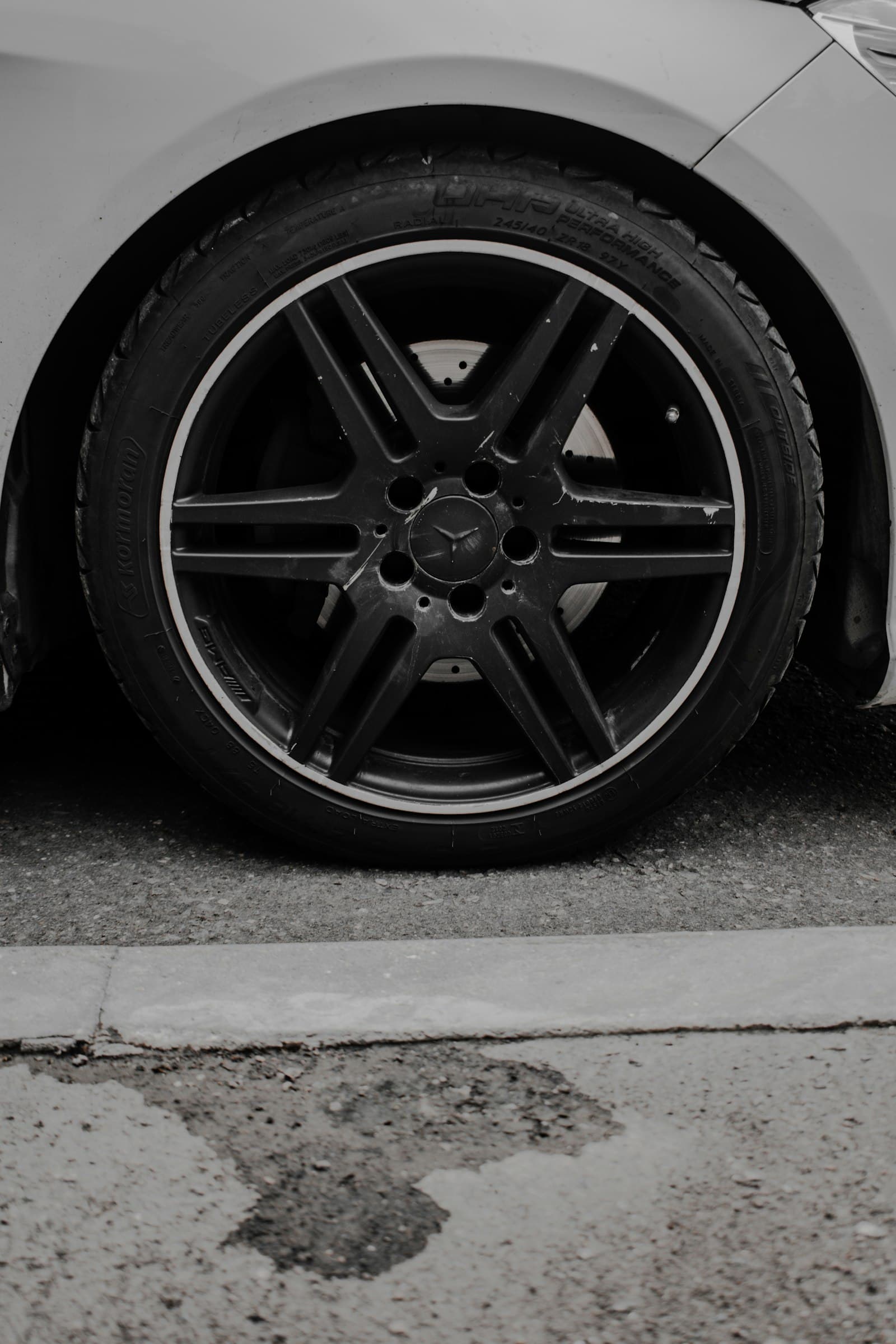
You aren't always tied to the exact tyre size currently on your car. Want a wider tyre or a bigger rim? That's possible if you follow a few rules.
The 2% rule
The outer diameter of the new tyre may be at most 2% larger or smaller than that of the original tyre. That keeps your speedometer, ABS and ESP working correctly.
How to calculate the outer diameter
Take a 205/55 R16 tyre:
- Sidewall height: 205 × 0.55 = 112.75 mm
- Rim: 16 × 25.4 = 406.4 mm
- Outer diameter: 406.4 + 2 × 112.75 = 631.9 mm
With 2% tolerance, the new tyre may measure between about 619 and 645 mm. A 225/45 R17, for example, comes to 634 mm, so it fits.
What else to check
- Load index: at least as high as on your certificate of conformity.
- Speed rating: at least as high, except for winter tyres with a sticker.
- Rim width: a wider tyre sometimes needs a wider rim.
- Clearance: the tyre must not rub against the wheel arch or suspension, even at full lock.
- The same size per axle: left and right must always match.
Does your certificate list another size?
Your certificate of conformity (COC) often lists several approved sizes. You may always use those.
See straight away which sizes stay within 2% in our tyre size calculator.